

Innovation is often measured by what gets added: new features, expanded capabilities, more powerful tools.
But in Governance Ops™, performance is just as often shaped by what gets refined.
The work rarely breaks all at once. It slows down in smaller ways: outputs that need to be adjusted before sharing, records that lack context, structures that show what exists but not how it changed. Individually, these gaps seem minor. Collectively, they create drag.
Governance work today spans legal, finance, tax and compliance. It supports audits, transactions, regulatory filings and strategic decisions, often under tight timelines and scrutiny.
In that environment, small inconsistencies compound quickly. Teams reformat outputs before sharing, verify data across systems and interpret records that lack the context needed to act.
None of this work is complex. But it is constant.
A focused step outside the roadmap
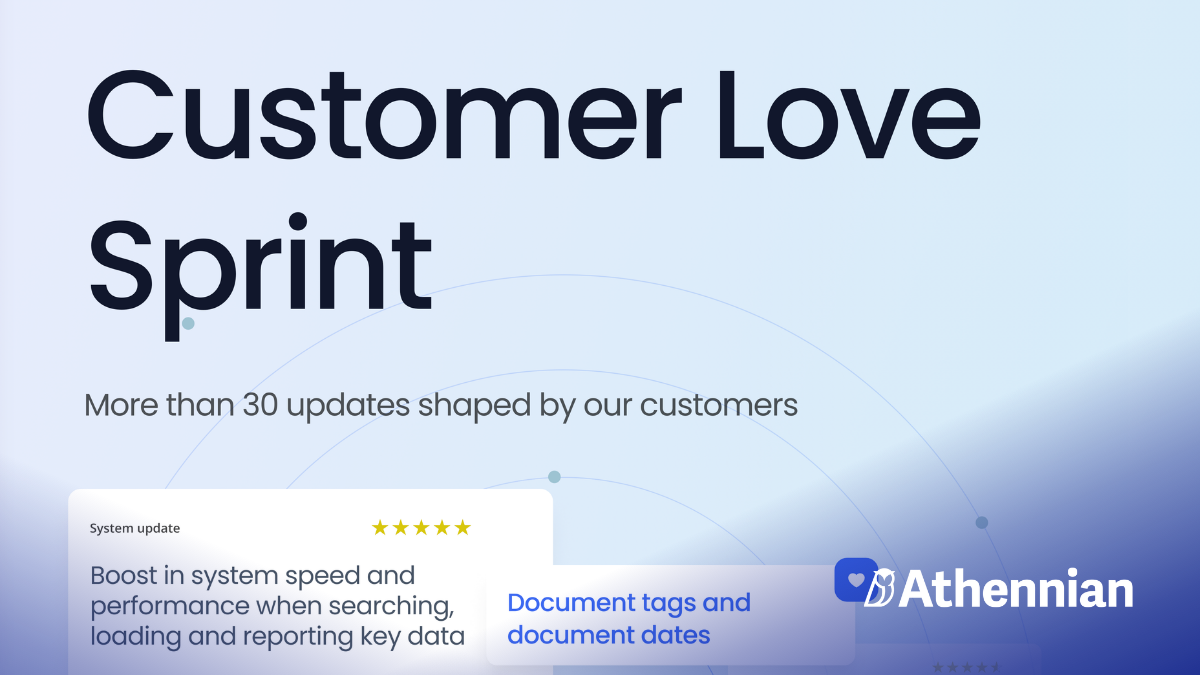
To address this directly, Athennian recently ran a Customer Love Sprint, a focused effort outside our standard roadmap dedicated to resolving high-impact friction identified through customer feedback.
Customer feedback, in this context, acts as an operational signal, highlighting where systems don’t fully support how work happens day to day. It surfaces where outputs need adjustment before they can be used, where context is missing at the point of decision and where workflows introduce unnecessary steps.
Over the course of the sprint, we delivered more than 30 targeted improvements across the platform.
Individually, many of these updates are small. Together, they meaningfully improve how teams work day to day.
What changed in practice
These changes are not abstract. They show up in the workflows teams rely on most:
More consistent, presentation-ready structure charts
Teams can now lock chart legends to preserve standardized formatting, reducing the need for manual adjustments before sharing with boards, auditors or investors. This reduces rework and ensures consistency across stakeholders without relying on manual intervention.
Better visibility into how structures evolve
Entity status is now visible and filterable directly within structure charts, making it easier to understand both current state and point-in-time changes. Teams can move from static views to usable insights without rebuilding context outside the system.
Clearer, more usable registration data
Custom registration sub-types allow teams to define more precise classifications across jurisdictions, improving how records are interpreted and managed at scale. This becomes especially important where ambiguity in classification slows reporting and increases risk.
Why these details matter
Governance Ops depends on more than capability. It depends on consistency, clarity and trust in the underlying data.
When systems require interpretation or manual adjustment, teams compensate. They add steps, double-check information and rely on institutional knowledge to fill gaps. Over time, that slows work down and increases risk. It also limits visibility across teams, making it harder to align on a single, trusted view of entity data.
Addressing those details directly changes the experience:
- Outputs are ready when they’re needed
- Data can be used without rework
- Workflows reflect how teams actually operate
The system becomes something teams can depend on, not something they have to work around.
Building where it counts
Large product innovations will always matter. They expand what teams can do.
But the day-to-day experience of governance work is defined in the details — whether outputs are consistent, context is available and teams can move from information to action without friction.
That’s where this sprint was focused. And it’s where we’ll continue to invest.
.svg)


.avif)

.avif)


-p-500.webp)
-p-500.webp)
-p-500.webp)
.webp)
